Introduction to Racing at the Provincetown Yacht Club
Races are held on Saturdays, starting at 2PM. They are postponed until Sunday if we have poor weather.
You can find more details about some of the following concepts (our race buoy coordinates, standard racecourse and the signal flags that we use) on our Resources for Racers page. Sailboat races follow strict rules established by World Sailing and US Sailing. We also have local rules, established by our race committee. You can find links to these on the same page our website.
We use marine radios (channel 72) to communicate among the participants.
Participants
There are two groups of people involved in a race:
Racers – usually the skipper and one or two crew. Because we use a handicap system, boats of all sizes can race each other. Our regular fleet is in the 19-25’ range: Rhodes 19, O’Day 19, Capris 22.
Race Committee (the people running the race)
The race committee uses two boats:
The Committee boat – a 22’ sailboat (with no mast) named Paolina.
An inflatable dinghy (which we primarily use to get to the committee boat at its mooring in the harbor)
Setting up the racecourse
At around noon, members of the race committee board the committee boat and motor into the harbor to assess the conditions for the race. Depending on various factors, most notably the wind direction and speed, the committee determines what course they will use and where they will set it up.
We use four “standard” courses (TL, TW, W, L) so that the racers can easily understand which race marks they will have to round and how many times they will do so. For example, L:
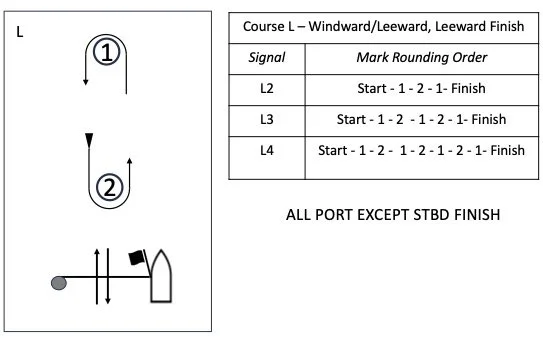
At the bottom of the diagram, you see the committee boat with a (yellow) flag and a dot to its left. The dot represents a large orange ball which we anchor in place. The start/stop line is between the flag on the boat and the orange ball in the water.
At the top of the diagram is a “race mark.” This is either an inflatable tetrahedron which we place on race day, or a “permanent” race mark/buoy that we place at the beginning of each season. (If you’re out on your boat in the harbor, you can see our four tall orange cylinders anchored in place. They have a PYC label and are lettered A, B, D, F).
If the racers are on an L2 course, they:
start behind the start line
sail to and around mark 1 (with the marks always on their port/left side)
sail to and around mark 2
sail to and around mark 1
sail to and through the finish line
L3 is a longer race and L4 is longer still. Less wind requires a shorter course.
Starting the race
The racers have a 5 minute countdown to the start of the race. The race committee provides a series of horns and flags to communicate the start sequence. Unlike a foot race, the sailboats do not start the race from a stopped position. Their goal is to cross the start line with as much speed as possible and on the tack appropriate to get to the first mark as quickly as possible. Naturally, they cannot cross the start line before the start of the race. This sounds a lot easier than it is!
The signals are:
Five minutes before the start of the race:
A horn
The “class flag” goes up on the port/left side of the race committee boat. The class flag is triangular with a white field and red dot.
Four minutes before the start of the race:
A horn
The “prep flag” goes up on the starboard/right side of the race committee boat. The prep flag has a blue square.
One minute before the start of the race:
A horn
The “prep flag” comes down
At the start of the race:
A horn
The “class flag” comes down.. and the racers are off!
Ending the race
Race committee notifies the racers that they have crossed the finish line with a short blast of the air horn. They also note each racer’s time on course (with a stopwatch). We use a handicapping system so that racers are not penalized for sailing in a slower boat. We use the length of the course and each boat’s handicap to determine their actual time on course.